“President“ Elon Musk just set off alarm bells with a chilling new speech that should deeply worry every American who cares about our struggling democracy.
Tyler Perry and Kerry Washington team up on the film "Six Triple Eight," spotlighting the only all-Black women's battalion in Europe during WWII. Washington stars as Charity Adams, the highest-ranking Black female officer.
Each weekday morning, "CBS Mornings" co-hosts Gayle King, Tony Dokoupil and Nate Burleson bring you the latest breaking news, smart conversation and in-depth feature reporting. "CBS Mornings" airs weekdays at 7 a.m. on CBS and stream it at 8 a.m. ET on the CBS News app.
Devastating Costs to America, Its Budget and Economy
Share this report:
Introduction and Executive Summary
In recent months, leading politicians and policymakers have renewed calls for mass deportations of immigrants from the United States. While similar promises have been made in the past without coming to fruition—during the 2016 presidential campaign, for example, Donald Trump pledged to create a “deportation force” to round up undocumented immigrants —mass deportation now occupies a standing role in the rhetoric of leading immigration hawks. To cite just one example, former U.S. Immigration and Customs Enforcement (ICE) director Tom Homan has promised “a historic deportation operation” should a hawkish administration return to power.While some plans have envisioned a one-time, massive operation designed to round up, detain, and deport the undocumented population en masse, others have envisioned starting from a baseline of one million deportations per year.
Given that in the modern immigration enforcement era the United States has never deported more than half a million immigrants per year—and many of those have been migrants apprehended trying to enter the U.S., not just those already living here—any mass deportation proposal raises obvious questions: how, exactly, would the United States possibly carry out the largest law enforcement operation in world history? And at what cost?
Using data from the American Community Survey (ACS) along with publicly-available data about the current costs of immigration enforcement, this report aims to provide an estimation of what the fiscal and economic cost to the United States would be should the government deport a population of roughly 11 million people who as of 2022 lacked permanent legal status and faced the possibility of removal. We consider this both in terms of the direct budgetary costs—the expenses associated with arrest, detention, legal processing, and removal—that the federal government would have to pay, and in terms of the impact on the United States economy and tax base should these people be removed from the labor force and consumer market.
In terms of fiscal costs, we also include an estimate of the impact of deporting an additional 2.3 million people who have crossed the U.S. southern border without legal immigration status and were released by the Department of Homeland Security (DHS) from January 2023 through April 2024. We consider these fiscal costs separately because we don’t have more recent ACS data necessary to estimate the total net changes in the undocumented population past 2022, or the larger impact on the economy and tax base of removing those people, an impact that is therefore not reflected in this report.
In total, we find that the cost of a one-time mass deportation operation aimed at both those populations—an estimated total of is at least $315 billion. We wish to emphasize that this figure is a highly conservative estimate. It does not take into account the long-term costs of a sustained mass deportation operation or the incalculable additional costs necessary to acquire the institutional capacity to remove over 13 million people in a short period of time—incalculable because there is simply no reality in which such a singular operation is possible. For one thing, there would be no way to accomplish this mission without mass detention as an interim step. To put the scale of detaining over 13 million undocumented immigrants into context, the entire U.S. prison and jail population in 2022, comprising every person held in local, county, state, and federal prisons and jails, was 1.9 million people.
In order to estimate the costs of a longer-term mass deportation operation, we calculated the cost of a program aiming to arrest, detain, process, and deport one million people per year—paralleling the more conservative proposals made by mass-deportation proponents. Even assuming that 20 percent of the undocumented population would “self-deport” under a yearslong mass-deportation regime, we estimate the ultimate cost of such a longer operation would average out to $88 billion annually, for a total cost of $967.9 billion over the course of more than a decade. This is a much higher sum than the one-time estimate, given the long-term costs of establishing and maintaining detention facilities and temporary camps to eventually be able to detain one million people at a time—costs that could not be modeled in a short-term analysis. This would require the United States to build and maintain 24 times more ICE detention capacity than currently exists. The government would also be required to establish and maintain over 1,000 new immigration courtrooms to process people at such a rate.
Even this estimate is likely quite conservative, as we were unable to estimate the additional hiring costs for the tens of thousands of agents needed to carry out one million arrests per year, the additional capital investments necessary to increase the ICE Air Operations fleet of charter aircraft to carry out one million annual deportations, and a myriad of other ancillary costs necessary to ramp up federal immigration enforcement operations to the scale necessary.
On deportations, Trump expects a ‘bloody story’ in second term
In case Donald Trump’s anti-immigrant vision wasn’t already ugly enough, he now expects his deportation plan to become “a bloody story” in a second term.
As brutal as Donald Trump’s family-separation policy was during his presidency, the Republican hasn’t ruled out a sequel in a possible second term. In fact, as recently as Friday, the GOP nominee’s running mate, JD Vance, also hedged on whether to expect another round of family separations if voters return Trump to power.
But in case that weren’t quite enough, it was something the Republican presidential hopeful said a day later that was every bit as jarring. As USA Today’s Rex Huppke noted in his latest column:
At his weekend rally in Wisconsin, Trump brought up his sadistic plan to deport millions of immigrants, and he spun a dizzyingly dishonest tale about immigrants: “In Colorado they’re so brazen they’re taking over sections of the state. And you know, getting them out will be a bloody story.”
Media’s Crisis Point: It’s Losing Relevance and Scorned in Trump Era. A Reboot May Be Next
Former President Trump's decisive victory Tuesday will cause media outlets — particularly those that fashioned themselves as nonpartisan — to rethink their strategies.
Former President Trump’s decisive victory Tuesday led to a shock wave that was felt in newsrooms across Washington, D.C., and New York. Everyone knew the polls were close and that a Trump win was a strong possibility, sure, but the scale of Trump’s win left one senior producer at a broadcast network stunned: “We are questioning our relevance right now,” they said Wednesday morning.
It was a sentiment shared by former Sen. Claire McCaskill, who lamented on MSNBC‘s Morning Joe: “I think we have to acknowledge that Donald Trump knows our country better than we do.”
Indeed, there are blaring red warnings signs for traditional media everywhere you look. Ratings for the broadcast and cable news channels saw steep declines in ratings from Nielsen (finals showed an average of 42.3 million people, down from nearly 57 million four years ago), with the lowest ratings in decades. The steepest drop was felt at CNN, which saw its numbers fall below MSNBC for the first election night since that channel launched nearly three decades ago. (A caveat: Network PR reps note that readership and viewership online spiked on Election Day, more in keeping with modern consumption patterns. But the value in someone watching a 20 second CNN clip on X or a stream on Roku Channel is much different than someone who tunes in on TV.)
Just when I start to think network television couldn’t get worse, along comes a promo for a new prime-time show that convinces me it has not hit bottom yet.
But, oh, what a long, sad, downward journey it has been for the once-mighty media brands of NBC, CBS, ABC and Fox.
CBS and NBC all but invented TV as we know it in the late 1950s, and they were among the most dominant economic, cultural and political forces in the nation for half a century.
Each new fall season, they put forth an impressive array of new series that both reflected and shaped the popular culture. Their news divisions played as large a role as any single institution in setting the national agenda.
Presidents made decisions of war and peace based on what the people sitting at their anchor desks reported and said. The host of a news program, like Edward R. Murrow on “See It Now,” could expose the danger of a demagogue like Joe McCarthy, when even the president wouldn’t take on the reckless senator from Wisconsin.
Today, the networks are ragged ghosts of that greatness, featuring prime-time schedules filled with on-the-cheap game shows and endless reality competitions, culturally empty reboots of series that spoke to zeitgeists long gone, and news desks mostly anchored by forgettable cookie-cutter personalities who make Peter Jennings, Tom Brokaw, Dan Rather, Walter Cronkite and David Brinkley seem Olympian in memory.
Could you imagine any president saying, “If I’ve lost Jeff Glor, I’ve lost Middle America,” as Lyndon Johnson did of Cronkite after the CBS anchorman declared the Vietnam War a lost cause and urged an “honorable” withdrawal in a special telecast? (If you’re not sure who Glor is, my point has been made.)
If it weren’t for live sports events, like NBC’s “Sunday Night Football,” I can honestly say I would rarely tune to any of the networks for anything other than in my job as media critic.
I am not alone. The ratings news for the networks is dismal. But then, it has been dismal for more than a decade. Steady erosion has become year-to-year double-digit declines in audience, especially among viewers ages 18 to 49.
Last December, Ad Age ran an analysis headlined: “Has the bottom fallen out of the broadcast TV ratings?” Crunching Nielsen data, it reported a loss in network viewing of 16 percent year to year. The news for the first half of this season is not expected to be any better, according to analysts.
The promo that sent me down the path of this dark meditation aired during one of those live sporting events that I do still watch, NBC’s game between the Green Bay Packers and Minnesota Vikings last Sunday. It touted three series debuting, returning or both in January that were supposed to get me excited about the second half of the prime-time season on NBC: Dwayne Johnson’s “The Titan Games,” “Ellen’s Game of Games,” starring Ellen DeGeneres, and “America’s Got Talent: The Champions.”
That’s two more game shows and the spinoff of a summer replacement series. I can hardy wait.
According to NBC’s promo, Johnson’s show, which premieres Jan. 3, “will offer everyday people the once-in-a-lifetime opportunity to compete in epic head-to-head challenges designed to test the mind, body and heart.”
It goes on to say, “Those who can withstand the challenge have the chance to become a Titan and win a grand prize of $100,000.”
A grand prize of $100,000? NBC and CBS were giving away more than that on game shows in their infancy when they were struggling to find a national audience large enough to impress Madison Avenue and stay in business.
With no talent costs except Johnson, and $100,000 in “grand prize” money, the only question is: Could you do a prime-time show any cheaper?
Jan. 8 will mark the start of a new season for the DeGeneres show, which is little more than a glossy spinoff of a feature segment on her syndicated daytime program.
As the network’s promo itself puts it: “DeGeneres serves as host and executive producer of the hour-long comedy game show, which includes supersized versions of the most popular and action-packed games from her award-winning daytime talk show.”
The big money here is $100,000 as well — not so supersized.
“America’s Got Talent: The Champions” debuts Jan. 7, though “debuts” might be stretching the meaning of the word in making it sound as if there is something substantially new here.
“Summer's hottest show, ‘America's Got Talent,’ is now ready to warm up winter!” NBC’s promo says. “This new spinoff features the most incredible and memorable acts from previous seasons ready to wow America all over again.”
Is there anything in that copy that does not say recycled, repurposed or repackaged? Maybe it’s just me, but I am not feeling the wow.
Sad to say, given the sorry state of network programming, these shows will probably do OK — better than, say, the reboot of “Magnum P.I.” on CBS. Although doing OK by network standards these days is a very low bar.
This is not to single out NBC for its midseason shows. CBS announced this week that it will be bringing Tim Tebow to prime time March 27 with “The Million Dollar Mile,” another reality-competition series featuring physical endurance. Yeah, that Tim Tebow, the failed NFL quarterback.
So, how did network TV become so diminished anyway?
There are a number of huge technological, sociological and lifestyle changes at play, which shredded the monopoly network TV enjoyed for decades thanks to friends in Congress. Probably the biggest single factor was new technology that allowed other platforms to end run the over-the-air control networks enjoyed as result of broadcast licenses issued by the Federal Communications Commission.
But I and many others have written volumes about that. What has not been so widely explored and explained is the way the networks, in their greed, gave away their journalistic and cultural dominance and authority.
For example, the networks for decades had been the place to go for coverage of national political conventions. But starting in the late 1990s, networks began cutting back on how much they would spend on coverage and how much airtime would be given to it. This was in part a result of new owners demanding that news divisions, which had been seen as part of the networks’ public service commitment, turn a profit.
By 2004, the networks were skipping entire nights of coverage to air summer reruns because they were more cost-effective. Summer reruns!
In 2008, when the nation had a rock star candidate in Barack Obama, the networks wanted to get back into the game. But it was too late: Cable, which had given the process of selecting presidential candidates the kind of time it deserved, owned the world of politics. Beyond the political and cultural authority and trust lost in that penny-pinching move were billions of dollars in political and other advertising that now goes to cable.
The same penny-wise network thinking led to the dearth of quality drama and surfeit of reality and game competition shows today.
I remember spending a hot summer’s day in 1997 in the Chelsea District of Manhattan on the set where Tom Fontana and Barry Levinson were producing a new series for HBO called “Oz.” It had not yet debuted, but listening to Fontana explain the concept and watching that fabulous cast and crew film this groundbreaking prison drama, I knew I would never see anything like it on a network television. I also knew the networks would be poorer for not having shows like this, and cable vastly richer. This was the real start of what is now widely considered the new golden age of drama.
Fontana came up in network TV as a writer on “St. Elsewhere” and showrunner on “Homicide: Life on the Street,” but the network industry preferred cheaper, cookie-cutter shows it could control and produce on assembly lines in its West Coast studios.
To get a great drama, you often had to deal with unpredictable, artistic creators and pay serious money to actors. While HBO and then streaming services like Netflix embraced such talent and endured big budgets to produce culturally relevant drama like “The Sopranos,” “The Wire” and “House of Cards,” the networks doubled down on cheap, highly manageable reality TV, competition and game shows.
And here we are today. How many network dramas do you still watch regularly besides NBC’s “This Is Us”?
But does it really matter that the networks betrayed their promise and now stink? New technology and cable and digital programmers have more than filled the void, resulting in a richer overall array of programs for American viewers, haven’t they?
Not for all viewers, unfortunately.
Just as there are two Americas when it comes to health care, college education, ability to buy a home and other quality-of-life matters, so it is with media options. For millions of Americans who cannot afford premium cable or streaming services, there are only the networks and our woefully underfunded public TV system. Those Americans who cannot afford the new designer channels and streaming services are being fed more and more junk food by the networks, which makes it impossible for them not just to enjoy the pleasures of quality programming, but to simply participate fully in this democracy.
I feel guilty every time I see a great documentary series, like “The Fourth Estate” on Showtime, which chronicled the challenges the New York Times faces in covering the Trump White House. I think about how many people cannot afford a premium service like Showtime, and how much more receptive that might make them to demagogues who call The Times “fake news.”
What those viewers get instead from the downsized networks of today are warped versions of the American Dream telling them that one day they will be standing in front of Simon Cowell and he will love the sound of their voice and they will be on their way to fame and fortune. Just keep singing, believing and buying those lottery tickets.
What makes me so angry is that the networks were granted control of the public airwaves in the Communications Act of 1934 after promising Congress they would be good “stewards” — that’s the word executives and lobbyists used in their testimony — and broadcast in the public interest even as they pursued their corporate goals.
They lied, and 84 years later, we are still paying for their sins.
A declining share of U.S. adults are following the news closely, according to recent Pew Research Center surveys. And audiences are shrinking for several older types of news media – such as local TV stations, most newspapers and public radio – even as they grow for newer platforms like podcasts, as well as for a few specific media brands.
Pew Research Center has long tracked trends in the news industry. In addition to asking survey questions about Americans’ news consumption habits, our State of the News Media project uses several other data sources to look at various aspects of the industry, including audience size, revenue and other metrics.
How we did this
The latest data shows a complex picture. Here are some of our key findings:
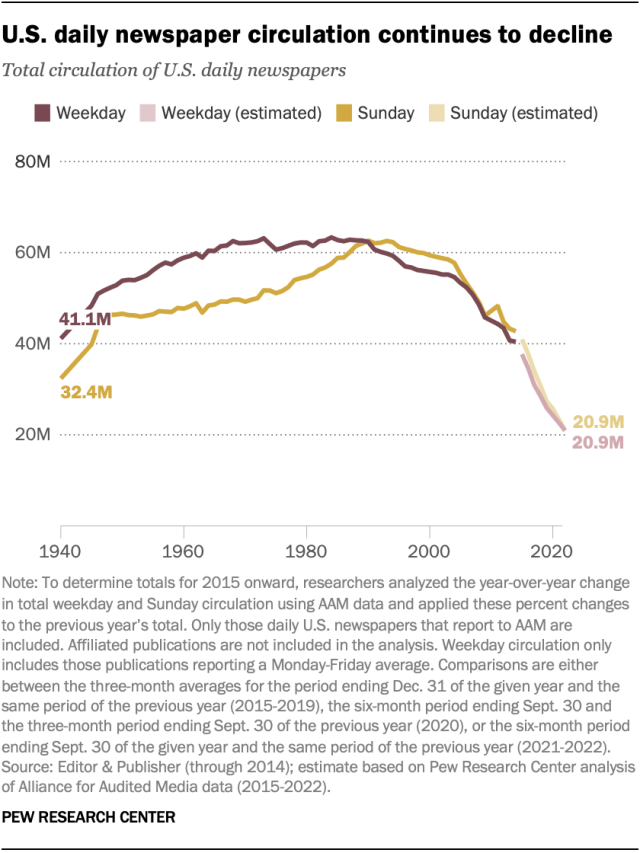
For the most part, daily newspaper circulation nationwide – counting digital subscriptions and print circulation – continues to decline, falling to just under 21 million in 2022, according to projections using data from the Alliance for Audited Media (AAM). Weekday circulation is down 8% from the previous year and 32% from five years prior, when it was over 30 million. Out of 136 papers included in this analysis, 120 experienced declines in weekday circulation in 2022.
While most newspapers in the United States are struggling, some of the biggest brands are experiencing digital growth. AAM data does not include all digital circulation to three of the nation’s most prominent newspapers: The New York Times, The Wall Street Journal and The Washington Post. But while all three are experiencing declines in their print subscriptions, other available data suggests substantial increases in digital subscriptions for The New York Times and The Wall Street Journal. (Similar data is not available for The Washington Post.) For example, The New York Times saw a 32% increase in digital-only subscriptions in 2022, surpassing 10 million subscribers and continuing years of growth, according to filings with the U.S. Securities and Exchange Commission (SEC). There are many reasons this data is not directly comparable with the AAM data, including the fact that some digital subscriptions to The New York Times do not include news and are limited to other products like cooking and games. Still, these brands are bucking the overall trend.
Overall, digital traffic to newspapers’ websites is declining. The average monthly number of unique visitors to the websites of the country’s top 50 newspapers (based on circulation, and including The New York Times, The Wall Street Journal and The Washington Post) declined 20% to under 9 million in the fourth quarter of 2022, down from over 11 million in the same period in 2021, according to Comscore data. The length of the average visit to these sites is also falling – to just under a minute and a half in the last quarter of 2022.
Traffic to top digital news websites is not picking up the slack. Overall, traffic to the most visited news websites – those with at least 10 million unique visitors per month in the fourth quarter of a given year – has declined over the past two years. The average number of monthly unique visitors to these sites was 3% lower in October-December 2022 than in the same period in 2021, following a 13% drop the year before that, according to Comscore. The length of the average visit to these sites is getting shorter, too. (These sites can include newspapers’ websites, such as that of The New York Times, as well as other digital news sites like those of CNN, Fox News or Axios.)
Trump says his mass deportation plan has ‘no price tag’ as he prepares to boot millions from the country
Trump’s militarized removals could cost billions while upending the economy and ripping families and communities apart
Donald Trump has repeatedly promised to carry out the “largest deportation operation in American history,” deploying federal, state and local law enforcement to arrest, jail and deport potentially millions of people living in the country without legal permission.
A militarized operation would depend on detention camps to hold people marked for removal, and would invoke a centuries-old law previously used to detain Japanese Americans during the Second World War.
President-elect Trump told NBC News on Thursday, two days after defeating his Democratic rival Kamala Harris, that he has “no choice” but to implement large-scale deportations when he takes office in January.
“It’s not a question of a price tag,” he said. “It’s not — really, we have no choice. When people have killed and murdered, when drug lords have destroyed countries, and now they’re going to go back to those countries because they’re not staying here. There is no price tag.”
He told NBC News that he wants to “make the border strong and powerful and, and we have to — at the same time, we want people to come into our country.”
“And you know, I’m not somebody that says, ‘No, you can’t come in.’ We want people to come in,” he said. Using the full force of federal, state and local law enforcement agencies to identify, detain and deport millions of people living in the US without legal permission could cost more than $967 billion over 10 years, according to the American Immigration Council.
That is nearly the same amount that undocumented immigrants pay in federal, state and local taxes within a 10-year period, according to the Institute on Taxation and Economic Policy.
Undocumented immigrants paid federal, state, and local taxes of $8,889 per person in 2022, the group found. For every 1 million undocumented immigrants, public services receive $8.9 billion in tax revenue. Those immigrants, despite paying into government services like healthcare and Social Security, are not eligible for them.
According to Fox 2, multiple women in the Detroit area received messages on Wednesday (November 6) saying they had been selected to pick cotton.
"Good afternoon Renee! You have been chosen to pick cotton at your nearest plantation. Be ready at 10am with all of your personal items & possessions because you will never see them again," one text message to a Detroit-area resident read. "We will pick you up in a white bus. You will be checked for drugs & other substances! Once you make it here you will be brought to your designed area. You are in group 10B".
A second woman received a similar message from a different number, per Fox 2.
"Greetings You have been selected to pick cotton at the nearest plantation. Be ready at 12AM NOVEMBER 13 SHARP with your belongings. Our Executive Slaves will come get you in a Brown Van, be prepared to be searched down once you've entered the plantation. You are in Plantation Group D."
Both text messages were received the day after the presidential election.
Other local outlets across the country have reported similar instances. According to Fox 5 Atlanta, women in the area received similar messages including some about a potential threat from white supremacists and KKK members.
Several individuals in Virginia have also reportedly received racist messages. According to more reports, Black college students at the University of Alabama and Clemson University in South Carolina have been hit with the messages too.
In one message shared on Reddit, a Black American was "selected to be a house slave... after President Trump takes office."
It's unclear who is sending the messages. Some social media users speculated that the messages stemmed from efforts from Russia to divide Americans against each other.
See more of the racist messages shared by social media users below.
The Black Information Network is your source for Black News! Get the latest news 24/7 on The Black Information Network. Listen now on the iHeartRadio app or click HEREto tune in live.